AI Homework Rules: 5 Essential Guidelines to Prevent ChatGPT Cheating
AI Homework Rules: 5 Essential Guidelines to Prevent ChatGPT Cheating
AI homework rules aren’t optional anymore—they’re essential. If your child has asked “Can I use ChatGPT for this assignment?” you’re navigating the same uncertainty facing millions of parents today. The line between ethical AI use and academic dishonesty feels blurry because schools are updating policies at different speeds. This article cuts through the confusion with five actionable guidelines you can implement tonight.
Table of Contents
- What Schools Actually Mean by AI Cheating
- The Developmental Reality: Age Matters
- 5 Essential AI Homework Rules
- How to Talk to Your Child About AI
- When AI Use Becomes a Red Flag
What Schools Actually Mean by “AI Cheating”
When educators flag AI use as cheating, they’re responding to work that bypasses cognitive effort. Most schools evaluate three criteria:
- Substitution vs. support: Using AI to generate finished papers crosses into cheating. Using it to brainstorm topics stays in the support zone.
- Transparency: Undisclosed AI involvement equals academic dishonesty regardless of output quality.
- Skill bypass: Assignments targeting specific competencies become problematic when AI completes core tasks.
According to Education Week’s recent survey, 62% of districts now have AI-specific policies, but enforcement varies wildly. The safest approach? Teach your child to default to transparency.
The Developmental Reality: Why AI Homework Rules Change by Age
One-size-fits-all AI homework rules create friction. Cognitive development shifts dramatically between elementary and high school.
Elementary (Grades K–5): Foundational Skills First
Students build handwriting fluency, reading comprehension, and arithmetic automaticity. AI should function as a guided tutor only:
- ✅ Appropriate: Pronouncing unfamiliar words, asking follow-up questions about science topics
- ❌ Inappropriate: Drafting sentences, solving word problems, rewriting reading responses
- Why: Early learners need repeated, unassisted practice to move skills from working memory to long-term retention.
Middle School (Grades 6–8): Building Executive Function
Students learn to plan, organize, and revise. AI can scaffold these processes with boundaries:
- ✅ Appropriate: Generating essay outlines, explaining historical events simply
- ❌ Inappropriate: Copy-pasting paragraphs, bypassing reading assignments
- Why: Executive function is still maturing. Students who outsource planning lose self-monitoring skills.
High School (Grades 9–12): Independent Analysis
Older teens synthesize sources and construct arguments. AI becomes a research assistant, not an author. For more on teen boundaries, check our guide on teen screen time limits.
- ✅ Appropriate: Stress-testing arguments, checking citation formats
- ❌ Inappropriate: Submitting AI-generated essays, using AI for timed writing practice
- Why: Metacognition solidifies during these years. Over-reliance weakens critical thinking.
5 Essential AI Homework Rules You Can Implement Tonight
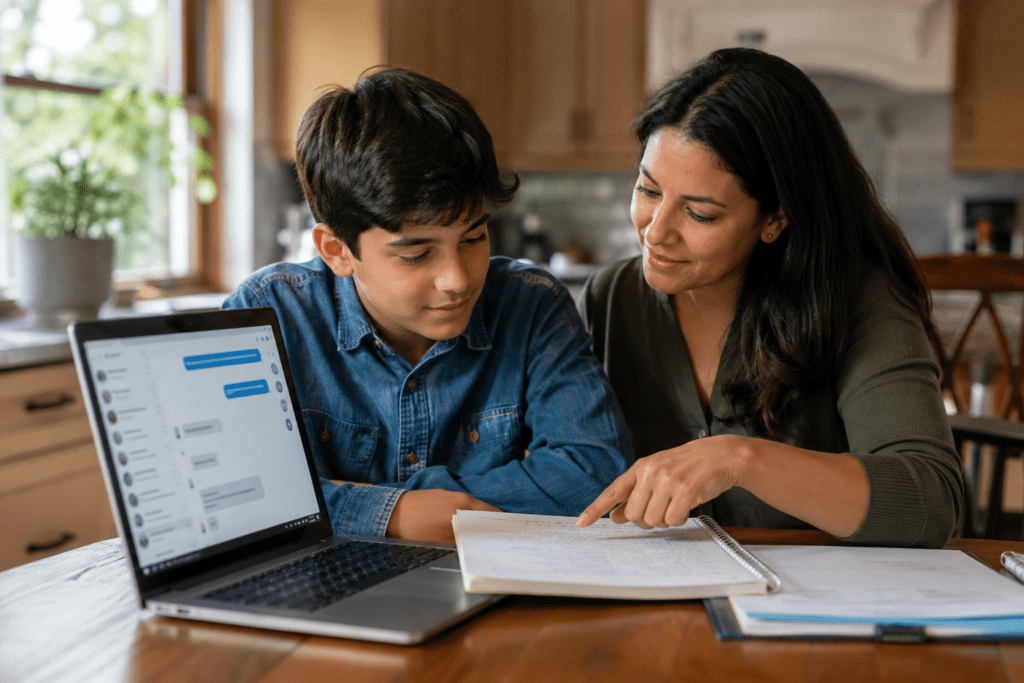
These AI homework rules don’t require monitoring every keystroke. They create enforceable boundaries aligned with school expectations.
Rule 1: Transparency First
The rule: If AI is used, it gets logged. Add a brief note at the assignment’s end: “Used ChatGPT to brainstorm three thesis options. All final writing is my own.” This removes guesswork for teachers and builds academic honesty habits.
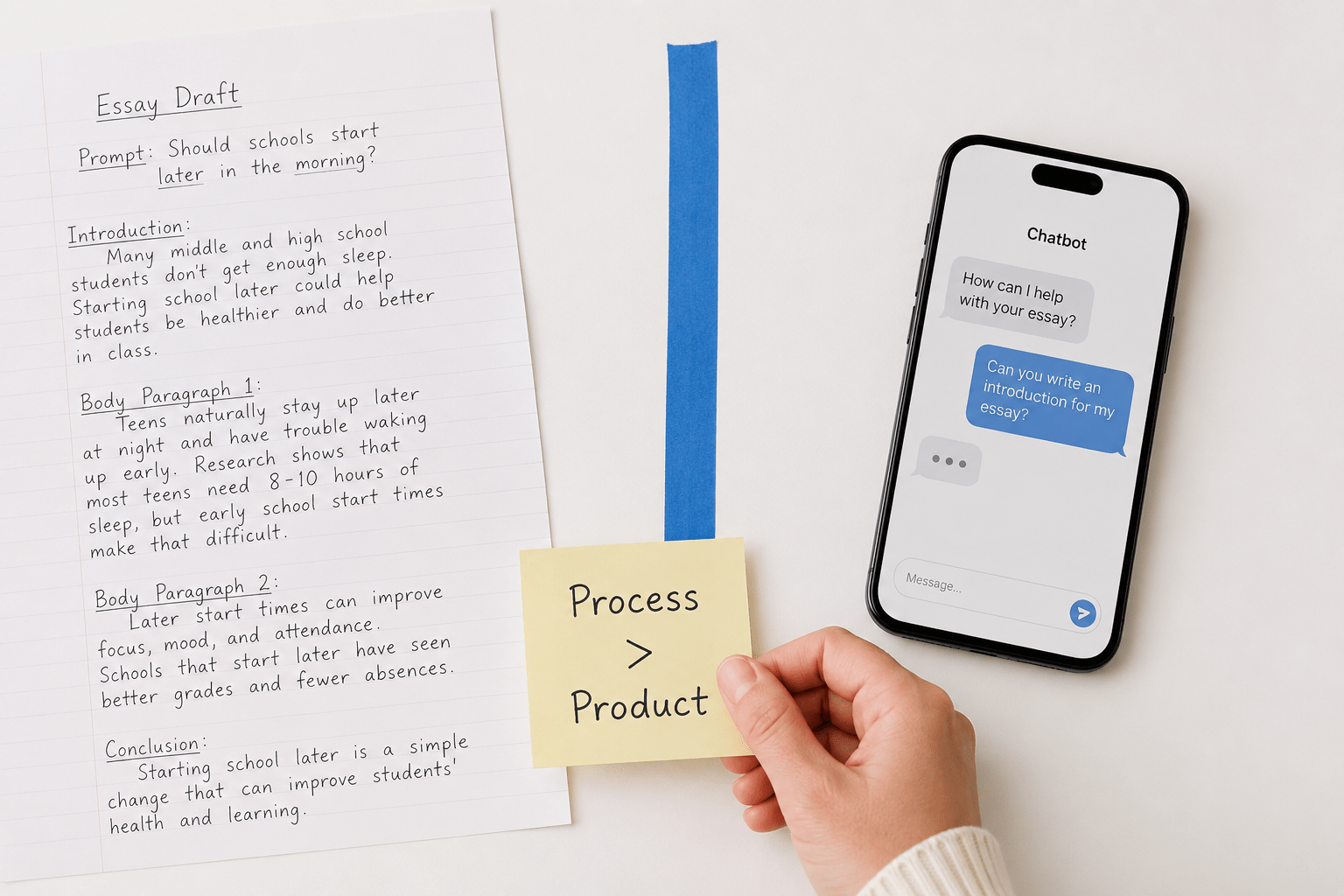
Rule 2: Process Over Product
The rule: AI handles steps, not outputs. Allow AI for outlining, explaining concepts, or checking grammar after drafting. Never allow it to generate the first full draft. Instead of “Write my essay,” the prompt becomes “Help me organize these three arguments logically.”
Rule 3: Verify Everything Manually
The rule: AI is a starting point, not a source. Cross-check facts against textbooks or peer-reviewed sources. Teach your child to ask: “Does this match what we covered in class?” AI hallucinates confidently—students who treat outputs as truth risk academic penalties.
Rule 4: Cite Like a Reference
The rule: Treat AI like any consulted tool. Follow school citation guidelines (MLA, APA, Chicago) to note AI assistance. Many districts now require standard acknowledgment formats. Keep a simple homework log: date, assignment, AI prompt used, and application.
Rule 5: Cap AI Time, Not Access
The rule: Set a 15–20 minute limit for AI assistance per assignment. After that, switch to handwritten drafting or independent problem-solving. Learning requires productive friction. Removing all challenge prevents neural pathway development.
How to Talk to Your Child About AI Without Starting a Fight
Policing AI homework rules backfires. Kids adapt by hiding usage or switching platforms. A collaborative approach works better.
Start with the goal: “I’m not trying to take away a tool. I want to make sure it helps you learn instead of making assignments harder later.” Acknowledge reality: “Yes, other kids use it. But teachers grade for thinking, not just completion.”
Use this three-step framework:
- Ask what they’ve used AI for already. Listen without interrupting.
- Map AI to their real pain points. If they struggle with starting essays, AI outlining makes sense.
- Co-write a one-page AI agreement. Kids comply better when they help build the framework.
For more on family tech agreements, see our family technology agreement template.
When AI Homework Use Becomes a Red Flag
Certain patterns signal AI is replacing skill development:
- Sudden jumps in writing quality without matching in-class performance
- Loss of personal voice or consistent phrasing that doesn’t match spoken style
- Avoidance of drafting, brainstorming, or showing work
- Grade drops on proctored assignments or oral explanations
- Defensive reactions when asked how they completed work
If you notice these, reset the system. Pause unrestricted AI use for one week. Return to handwritten drafts to assess baseline skills. Schedule a brief meeting with the teacher to align home rules with classroom expectations. Rebuild skill gaps through independent practice before reintroducing AI support.
Conclusion
AI homework rules protect the learning process, not ban technology. The clearest boundary between ethical use and cheating comes down to transparency, process over product, and age-appropriate limits. Start by requiring disclosure on every assignment. Allow AI to brainstorm or edit, but never generate final work. Cap usage time, verify outputs manually, and align home rules with teacher expectations. When AI supports effort instead of replacing it, your child gains a legitimate academic advantage. Set clear boundaries now, adjust as school policies evolve, and keep the focus on what matters: your child learning how to think.
For more practical parenting guides, explore our technology parenting resources.